Walk into any industrial supply store and you’ll find hydraulic oils labelled ISO 32, ISO 46, ISO 68 and if you don’t already know what those numbers mean, they tell you very little. Yet the grade you choose has a direct impact on how your hydraulic system performs, how long your components last, and whether your equipment holds up in the climate and load conditions it actually operates in.
This guide cuts through the technical language and gives you a practical understanding of what ISO grades mean, how the main grades compare, and how to match the right one to your equipment and environment.
What Does ISO Actually Mean?
ISO stands for the International Organization for Standardization. In the context of hydraulic oils, the ISO viscosity classification system formally ISO 3448 provides a standardised way to categorise oils by their kinematic viscosity at 40°C.
The number in the grade name 32, 46, 68 represents the midpoint viscosity in centistokes (cSt) at 40°C. Each grade has an acceptable viscosity range of ±10% around that midpoint. So ISO 46, for example, has a viscosity range of approximately 41.4 to 50.6 cSt at 40°C.
What this standardisation achieves is consistency. When an equipment manufacturer specifies ISO 46 hydraulic oil, they’re specifying a defined viscosity range not a particular brand or formulation. Any oil labelled ISO 46 from any reputable manufacturer should fall within that range, which is why ISO grades are used universally across OEM specifications, maintenance manuals, and procurement systems worldwide.
Viscosity, in simple terms, is the oil’s resistance to flow. Higher ISO numbers mean thicker oil that flows more slowly. Lower numbers mean thinner oil that flows more easily. Both have their place; the key is matching the viscosity to the system’s operating conditions.
ISO 32, ISO 46, ISO 68: How They Compare
These three grades cover the vast majority of industrial hydraulic applications. Understanding where each one fits helps make the selection decision straightforward.
ISO 32 — The Light Grade
ISO 32 is the thinnest of the three common industrial grades. It flows easily at low temperatures and suits systems that operate at lower pressures or where the equipment generates relatively little heat.
It’s commonly specified for:
- Machine tools and CNC equipment
- Light-duty hydraulic systems in moderate climates
- Systems operating in cooler ambient temperatures (below 20°C)
- High-speed hydraulic circuits where low viscosity aids efficiency
The trade-off with ISO 32 is that it offers less film thickness protection under high load. In heavy-duty applications or high-temperature environments, it can thin out to the point where the protective oil film between moving surfaces becomes inadequate.
ISO 46 — The Industrial Standard
ISO 46 is the most widely used hydraulic oil grade in industrial applications globally and for good reason. It strikes the best balance between flow characteristics and film strength for the broadest range of operating conditions.
Most industrial hydraulic systems presses, injection moulding machines, material handling equipment, industrial robots are designed with ISO 46 in mind. It performs reliably across a moderate temperature range, handles typical industrial load cycles well, and is the default specification for a large proportion of hydraulic equipment manufactured over the past three decades.
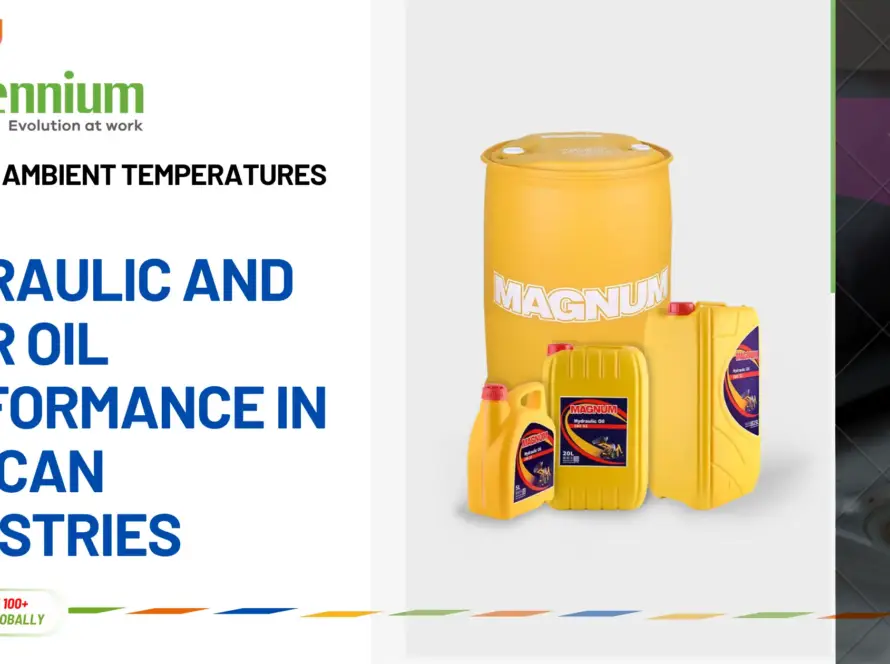
Magnum Hydraulic Oil ISO 46 is formulated to deliver consistent viscosity performance across this operating range, with strong anti-wear additives, oxidative stability, and foam resistance properties that matter in systems running continuous production cycles.
If you’re unsure which grade your system requires and the OEM documentation isn’t available, ISO 46 is almost always the safer starting assumption for general industrial hydraulic equipment.
ISO 68 — The Heavy-Duty Grade
ISO 68 is a thicker oil suited to high-load, high-temperature, or slow-speed hydraulic applications. Where ISO 46 might thin out under sustained heavy load or elevated ambient temperatures, ISO 68 maintains a more protective film.
It’s commonly specified for:
- Heavy presses and forging equipment
- Slow-speed hydraulic systems under high load
- Equipment operating in hot climates or high-temperature environments
- Large-volume hydraulic systems where thermal mass keeps temperatures elevated
The limitation of ISO 68 in cooler conditions is that its higher viscosity can increase energy consumption at startup and may cause sluggish response in high-speed circuits. In cold climates, it’s generally not the right choice without a system warm-up procedure.
Climate Considerations: Getting This Right Matters More Than You Think
Ambient temperature is one of the most important and most frequently underestimated factors in ISO grade selection. It’s particularly relevant for operations in Africa, the Middle East, and other regions where ambient temperatures regularly exceed 35°C to 45°C.
Here’s why it matters: hydraulic oil viscosity decreases as temperature rises. An oil that’s at the correct viscosity at 40°C will be noticeably thinner when the actual operating temperature climbs to 70°C or 80°C under load in a hot environment. If you’re running ISO 32 or even ISO 46 in a high-ambient-temperature environment without adequate cooling, the oil may thin beyond its protective capability during peak operating periods.
As a practical guide:
- Cool climates (below 20°C ambient): ISO 32 is often appropriate, with ISO 46 also suitable if the system has a warm-up period
- Moderate climates (20°C to 35°C ambient): ISO 46 is the standard choice for most applications
- Hot climates (35°C+ ambient): ISO 46 with good thermal stability, or ISO 68 for heavy-load applications where operating temperatures run consistently high
This is one area where the climate realities of African and Middle Eastern industrial operations genuinely diverge from the European or North American contexts in which much hydraulic equipment is originally designed and specified. A system specified for ISO 46 in a European factory may genuinely benefit from ISO 68 when relocated to a facility in the Gulf or sub-Saharan Africa.
How to Select the Right ISO Grade for Your Equipment
A systematic approach to grade selection avoids the guesswork that leads to premature component wear or energy inefficiency.
Start with the OEM specification. The equipment manufacturer’s recommendation is always the primary reference. It’s based on the system’s design operating pressure, flow rates, component clearances, and intended temperature range. Deviating from it without a specific technical reason introduces risk.
Factor in your actual operating temperature. If your facility runs significantly hotter than the climate the equipment was designed for, consider moving up one grade. If you’ve added supplementary cooling, the OEM spec should hold.
Consider your load profile. Continuous heavy-load operation generates more heat than intermittent light-duty cycles. Systems running near their rated capacity for extended periods benefit from the additional film strength of a higher grade.
Account for system age. Older hydraulic systems with more internal wear often benefit from a slightly higher viscosity grade, as worn components have larger clearances that thinner oils don’t seal as effectively.
Frequently Asked Questions About Hydraulic Oil ISO Grades for Industrial Applications
What does ISO mean in hydraulic oil?
Which ISO grade suits hot climates?
How do you select the right ISO grade?
Putting It All Together
ISO grade selection isn’t complicated once you understand what the numbers actually mean. Viscosity at operating temperature is the core variable and matching it correctly to your system’s load, speed, and climate conditions is what protects your components, maintains system efficiency, and extends equipment life.
For most industrial hydraulic applications, Magnum Hydraulic Oil ISO 46 covers the majority of requirements reliably. In hotter environments or under heavier loads, ISO 68 steps in where ISO 46 reaches its limits. And for lighter, faster systems in cooler climates, ISO 32 offers the flow characteristics those applications need.
The right grade, consistently used and monitored, is one of the simplest and most effective things you can do for long-term hydraulic system reliability.